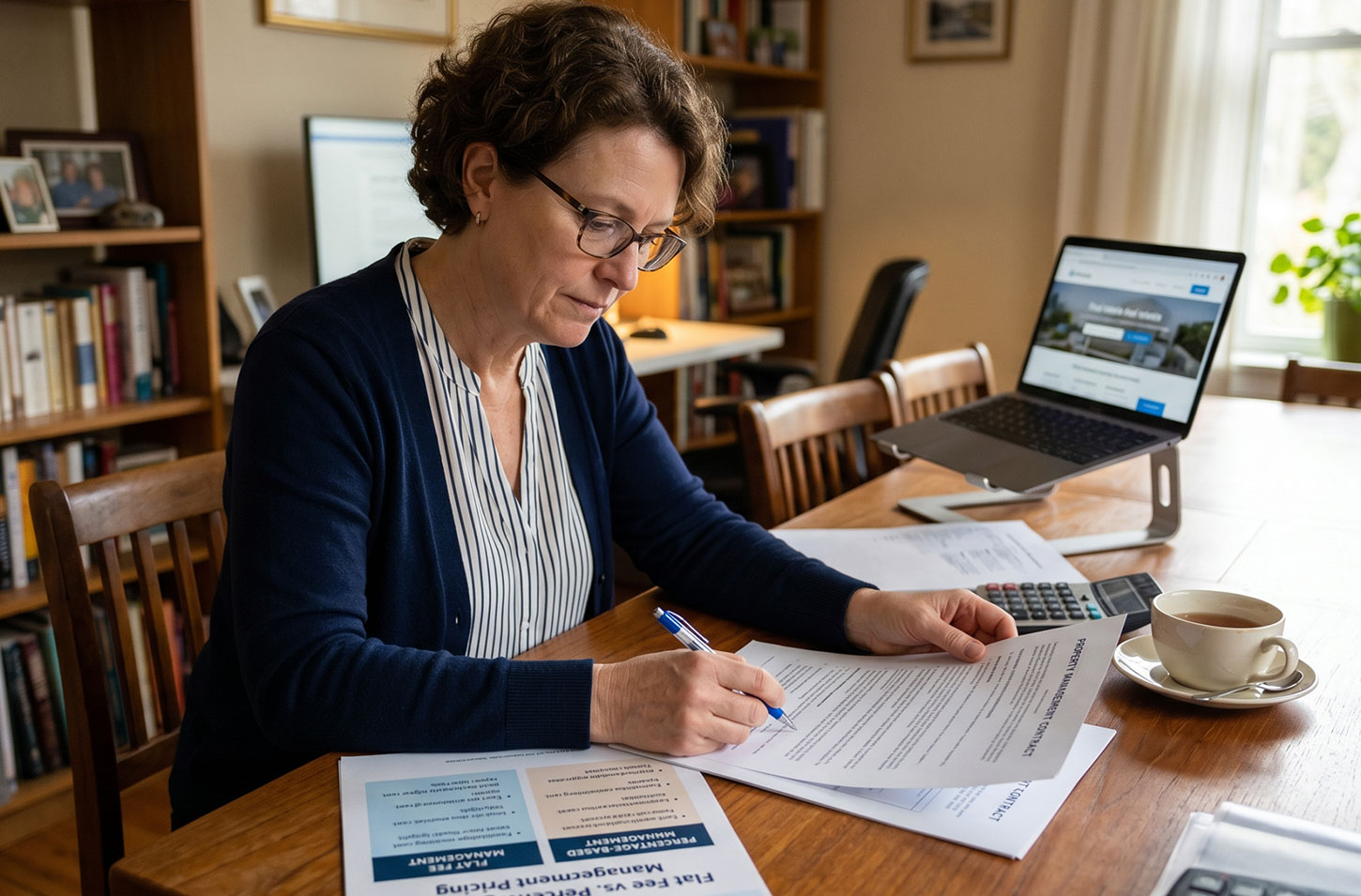
Most Brisbane landlords do not know exactly what they are paying their property manager each year until they sit down and add it all up. The industry has built its fee structure around complexity — and complexity almost always benefits the agency, not the owner.
There are two main fee models in Australian property management: percentage-based and flat fee. Understanding the real difference between them — not just the headline rate — is one of the most useful things a property investor can do.
How Percentage-Based Property Management Works
The percentage model is what most Brisbane agencies use. The agency charges a percentage of the weekly rent as their ongoing management fee — typically between 7.7% and 10% in Brisbane, though some agencies charge as high as 12%.
At first glance, a percentage fee sounds straightforward. But the management percentage is almost never the full picture. Percentage-based agencies typically charge a range of additional fees on top of their base rate. These are often disclosed in fine print, or listed as separate line items on monthly statements.
Common Add-On Fees in Percentage-Based Management
- Letting fee — charged each time a new tenant is placed, commonly one to two weeks rent. On a $600/week property, that is $600–$1,200 per tenancy.
- Routine inspection fee — many agencies charge $80–$150 per inspection, typically conducted four times per year. That is $320–$600 annually, on top of the management fee.
- Lease renewal fee — charged when an existing tenant signs a new fixed-term lease, commonly $150–$300 per renewal.
- Administration or statement fee — a monthly or annual charge for producing statements, sometimes $5–$15/month.
- Maintenance administration fee — some agencies charge a percentage (typically 5–10%) of each repair invoice as an administration margin, on top of the actual repair cost.
- QCAT or tribunal attendance fee — charged if your manager needs to attend a Queensland Civil and Administrative Tribunal hearing on your behalf, often $150–$350 per appearance.
- Photography and advertising fees — charged when your property is listed, varying from $100 to $400+ depending on the agency.
Key point: When comparing property managers, always ask for a complete fee schedule — not just the management percentage. The advertised rate and the actual cost can differ significantly once all add-ons are included.
The Real Cost: A Brisbane Example
Let us compare the actual annual cost for a Brisbane property renting at $600 per week, using a typical percentage-based manager versus a flat fee manager.
- Management fee (8.8%): $2,746/yr
- Letting fee (1 wk, every 2 yrs avg): $300/yr avg
- Inspections (4 × $110): $440/yr
- Lease renewal: $200/yr
- Admin/statement: $120/yr
Total: ~$3,806/yr
- Management fee ($39 × 52): $2,028/yr
- Tenant placement ($550, every 2 yrs avg): $275/yr avg
- Inspections: included
- Lease renewals: included
- Statements & admin: included
Total: ~$2,303/yr
At $600/week rent, the flat fee model saves approximately $1,503 per year. Over a five-year holding period, that is over $7,500 — without accounting for fee increases that often follow rent increases under a percentage model.
At higher rent levels, the saving grows further. A property renting at $750/week would pay roughly $4,600–$5,000 per year under a percentage model versus around $2,400 under a flat fee structure — a difference of more than $2,000 annually.
Why the Gap Widens as Rent Increases
This is a fundamental structural problem with percentage-based management. When your rent increases — as a result of a successful rent review that your manager conducted — your management fee increases too. The manager's cost of providing the service does not increase meaningfully when rent goes from $600 to $650 per week, but under a percentage model, their fee does.
A flat fee does not penalise you for achieving higher rent. Your $39/week stays $39/week regardless of what your property earns. That alignment of incentives is one of the less obvious but more important advantages of the flat fee model.
How Flat Fee Property Management Works
A flat fee manager charges a fixed dollar amount per week, regardless of the property's rental income. A genuine all-inclusive flat fee covers everything involved in ongoing management — there are no separate line items for inspections, renewals, or routine correspondence.
The only additional charge in a true flat fee model is a one-off tenant placement fee when a new tenant is placed. This covers the leasing process: advertising, screening, references, lease preparation, and bond lodgement. At Housit, this is $550 or one week's rent, whichever is lower — and it only applies when a new tenant moves in.
Everything else — routine inspections and written reports, maintenance coordination, lease renewals, annual rent reviews, EOFY statements, RTA correspondence — is included in the weekly fee.
What a Flat Fee Should Cover: The Non-Negotiables
Not all “flat fee” managers are equal. Some advertise a flat fee but still charge for inspections, renewals, or maintenance administration. Before signing with any manager, ask specifically whether these are included:
- Routine inspections (at least three to four per year) and written reports
- Lease renewals and fixed-term extensions
- Annual rent reviews
- Maintenance coordination (no administration margin on top of repair costs)
- End-of-financial-year statements
- All standard tenant and owner correspondence
- Bond management and RTA lodgements
If any of these attracts an additional fee, the model is not genuinely flat fee — it is percentage management with a different presentation.
When Might Percentage-Based Management Make Sense?
There is one scenario where percentage-based management could theoretically be cheaper: a very low-rent property. If a property rents for $300/week or less, the percentage management fee may fall below $39/week. At $300/week and 10%, the management fee would be $30/week — though even then, once letting fees, inspection fees, and renewals are added, the total annual cost would likely still exceed the flat fee model.
For the vast majority of Brisbane properties — which rent for considerably more than $300/week — the flat fee model delivers a lower total cost, greater transparency, and better alignment of incentives between the owner and the manager.
Questions to Ask Any Property Manager About Their Fees
Before appointing a property manager, ask for answers in writing to the following:
- What is your ongoing management fee, and is it a percentage or a flat rate?
- What does that fee include? List every service covered.
- What fees are charged separately on top of the management fee?
- What is your letting fee when a new tenant is placed?
- Do you charge for routine inspections, and if so, how much and how often?
- Do you charge a lease renewal fee?
- Do you take a margin on maintenance invoices?
- Are there any monthly or annual administration charges?
- Is there a lock-in contract? If so, what notice is required to exit?
Any reputable manager should answer all of these questions clearly and in writing before you sign. If they are vague, or if the answer to several of them is “yes, there is an additional charge,” factor those costs into your comparison before deciding.
Frequently Asked Questions
Is a 7% property management fee good in Brisbane?
A 7% management rate is on the lower end for Brisbane, but the base percentage alone does not tell you the full cost. You need to factor in letting fees, inspection fees, renewal fees, and any other charges to compare accurately. A 7% manager who charges four inspection fees, a letting fee, and a renewal fee per year may cost more than an 8.8% manager who includes those services — and both may be more expensive than a flat fee manager who includes everything.
Can I negotiate property management fees in Brisbane?
Some agencies will negotiate on their management percentage, particularly if you have multiple properties or a long tenancy in place. However, negotiating a lower percentage rarely eliminates the add-on fee structure — the agency still makes margin on inspections, renewals, and lettings. A flat fee manager removes the need to negotiate entirely by charging one transparent rate.
What is a reasonable property management fee in Queensland?
A reasonable all-inclusive rate for Queensland property management should cover all ongoing services for around $2,000–$2,500 per year on a typical Brisbane property. If your current management costs are significantly higher than this, it is worth reviewing your fee structure against what is actually being delivered.
Do flat fee property managers provide the same level of service?
A lower fee does not mean lower service. The flat fee model is more efficient — it removes the overhead of calculating percentage fees, issuing separate invoices for add-ons, and justifying multiple line items on owner statements. Well-run flat fee agencies use that simplicity to focus on the actual work of property management. Look for reviews, response time guarantees, and clear communication practices rather than using fee model as a proxy for quality.
Housit charges $39 per week, all-inclusive — routine inspections, lease renewals, maintenance coordination, EOFY statements, and everything in between. No inspection fees, no renewal fees, no margin on maintenance. The only additional charge is a one-off tenant placement fee of $550 or one week's rent, whichever is lower. See the full pricing breakdown →